Inspired Italians
Italy has been making wine for over 4,000 years, thanks to the creativity of its early civilisations. The Etruscans and Greeks were the first to plant vines, but the Romans took winemaking further by improving grape cultivation and spreading wine throughout their empire. They even called the region Oenotria, which means the land of wine.
Today, Italian wine is known for its quality and variety, with over 500 native grape types and many unique climates. From the hills of Piedmont to the sunny vineyards of Tuscany and Sicily, Italy combines old traditions with new ideas in winemaking.
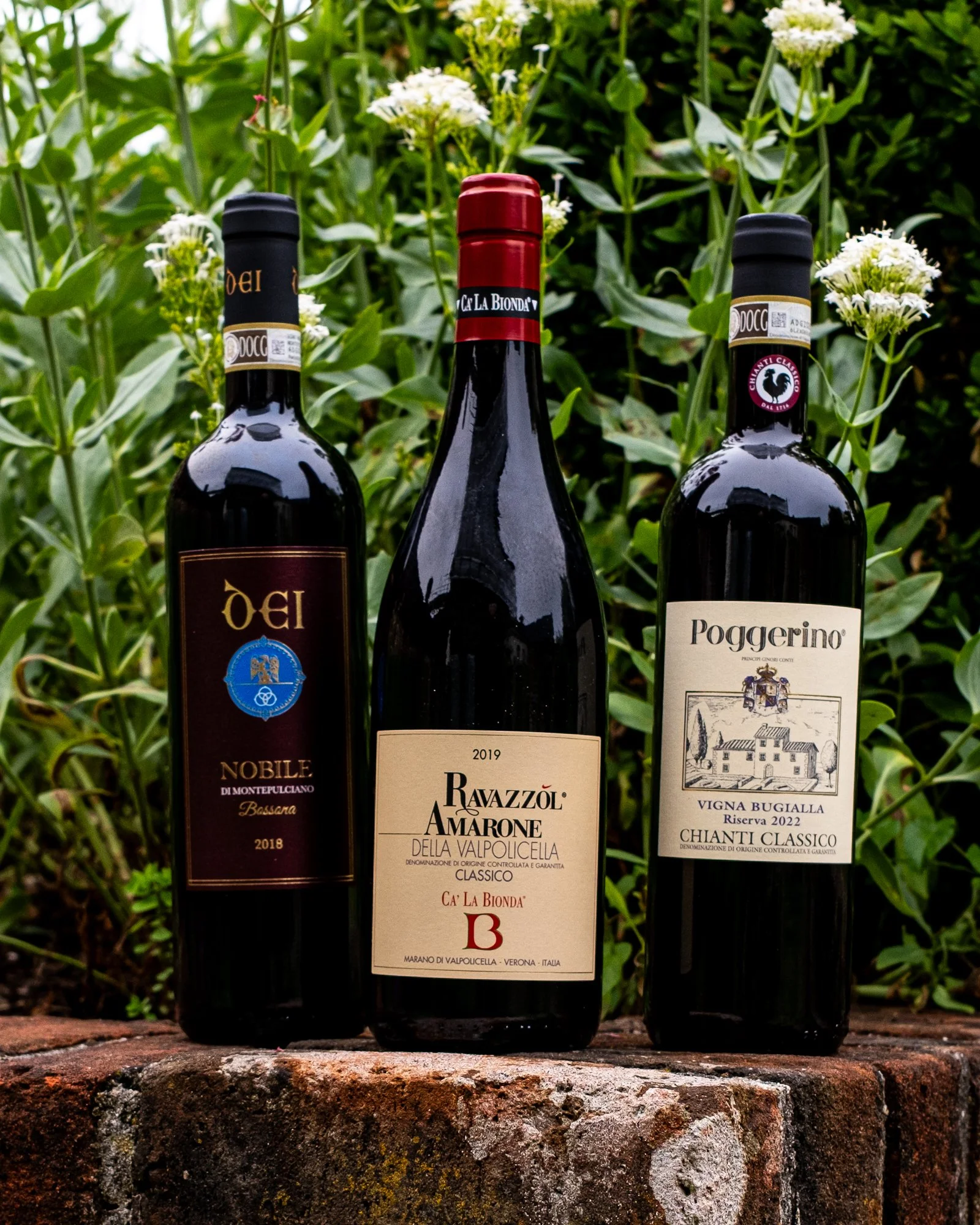
The three wines here were tasted among others from the wine merchant, Lea & Sandeman. They differ in style but share a common richness, depth, and concentration that easily place them in the 'decadent' category. They will all improve with age, and to thoroughly enjoy them today, you need to decant an hour or so before they are needed to show their true potential.
1 - Chianti Classico Riserva Bugialla 2022, Poggerino
Piero Lanza stands out as one of Chianti's most dynamic young ambassadors. With expertise as an oenologist, a skilled agronomist, and a visionary winemaker, he has elevated his wines to new heights in recent years. Nestled in the heart of the Chianti Classico district, his estate spans 106 acres of lush vineyards, silvery olive groves, and tranquil woodlands.
His mother inherited the winery from her father in the 1970s and began producing a Chianti Classico under the "Poggerino" label in 1980. Just 11 hectares are devoted to vines, nearly all Sangiovese, allowing for an intimate connection with the land.
Radda is one of the primary municipalities that sits in the centre of Chianti Classico and is known for its outstanding Sangiovese wines. Its vineyards stretch from 350 to 600 meters above sea level, making it one of the highest spots in the region. This elevation brings cooler air, which helps the grapes ripen slowly and keeps their bright acidity, complex aromas, and fresh character. As climate change affects Tuscany’s vineyards, these natural benefits have become even more important.
The steep hillsides shape the land, provide excellent drainage, and offer a mix of vineyard exposures. Southern slopes get plenty of sun and help the grapes ripen, while the cooler eastern and northern slopes keep the wine’s acidity and elegance. Forests around the vineyards help balance the climate, support local wildlife, and reduce large temperature swings between day and night during the growing season.
There is a concentration here that simply entices you to smile. Cherries on the nose with a touch of raspberry, and then the palate continues with cherry, red plum, raspberries, dried herbs, and earthy mineral notes. It just sits and sits, evolving in your mouth as you savour the finely grained tannins working with energetic acidity and rich fruit. It is exquisite today, but will certainly drink into the early 2030s.
£35.24 -case price - Lea & Sandeman - merchant link
2 - Amarone della Valpolicella Classico Ravazzol 2019, Ca' La Bionda
The most decadent of the three. A captivating, voluptuous, rich and very desirable concoction from this fourth-generation wine family.
There are many different styles of Valpolicella. For the Amarone style, the grapes are carefully arranged in shallow trays or plastic crates and carried to airy drying lofts called fruttai immediately after the harvest. In the past, only the natural breeze would sweep through these spaces, but today, many wineries use precise ventilation to guide the process. Over three to four months, often stretching into the chill of January or February, the grapes slowly surrender 30 to 45 per cent of their weight to evaporation. This patient transformation intensifies their sugars, flavours, colour, tannins, and glycerol, while weaving in rich aromas of dried cherry, fig, raisin, plum, and spice.
When the drying is finished, the grapes are gently crushed and set to ferment. The must, brimming with sugar, ferments slowly, sometimes taking weeks to complete its transformation. The wine that emerges boasts robust alcohol levels, usually between 15 and 17 ABV, yet still holds onto remarkable depth and structure. This appassimento method produces a wine style called passito. At Ca' La Bionda, the dried grapes are fermented in stainless-steel tanks, and the wine is then aged for 42 months in 3000-litre oak vats.
The vineyard for this wine spans 29 hectares from the Ravazzol hill at an altitude of 150 to 300 meters above sea level, with an east-south-east exposure. Both the palate and the nose are deeply concentrated. The nose is complex, with red-fruit flavours that combine with nutty, volatile notes from oxidative ageing. On the palate, there is an abundance of rich, elegant flavours of cherries, pepper, dried tobacco, with hints of balsamic, spice, tar, leather and powdered liquorice. Late 2030s.
£57.50 - case price - Lea & Sandeman - merchant link
3 - Vino Nobile di Montepulciano Bossona Riserva 2018, Cantine Dei
In Montepulciano, the Tuscan Sangiovese grape is known as Prugnolo Gentile. This is a flawless example that reminds us all that superlative wines from Tuscany can be made with their tried-and-tested Sangiovese rather than the international varieties favoured in Bolgheri. It was the grandfather of the current owner and winemaker, Caterina Dei, who bought this land in 1961. The vineyard sits at an elevation of between 350 and 400m, with a complex soil structure.
Savoury, elegant and refined on the nose with touches of spice, dark plums, mint and dark chocolate. Intensity and finesse on the palate with smoothly developed and velvety tannins, sitting alongside cherries, plums and developing spices. Long with charm and an abundance of style. Will drink well into the 2030s.
£60.75 - case price - Lea & Sandeman - merchant link